Blog

How E.ON Cut IT Downtime by 77% and Built a Foundation for Grid-Scale AI
June 3, 2026

The transition to green energy isn’t just a hardware challenge of building wind turbines and solar farms—it is fundamentally a data challenge. For European utility giant E.ON, managing a digital ecosystem that serves 47 million users across energy grids, customer solutions, and infrastructure requires massive operational resilience.
To modernise its footprint, E.ON executed a sweeping digital transformation, anchoring its strategy on SAP S/4HANA migration, cloud integration, and a massive in-sourcing of technical talent.
The results speak for themselves: a 77% reduction in IT downtime over a five-year period and a battle-tested architecture ready for enterprise-grade artificial intelligence.
1. Eradicating Technical Debt through Standardisation
Legacy systems in the utility sector are notoriously plagued by extreme customisation—a patchwork of fragmented custom builds that create immense technical debt. E.ON’s engineering department took a hard line against this approach:
- Direct Integration: Developers integrated established software packages directly into a cohesive architecture rather than building bespoke solutions.
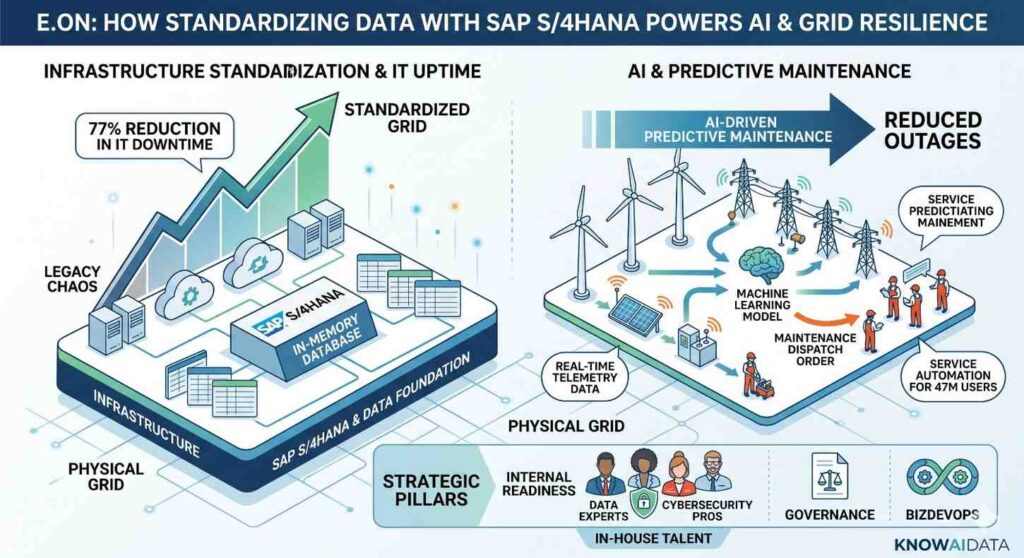
- Streamlined Data Stack: Achieving their 77% downtime reduction required standardising data tables and aggressively stripping out redundant middleware.
- Real-Time Telemetry: By leveraging SAP S/4HANA’s in-memory database architecture, E.ON accelerated query processing times. This allows them to process live telemetry data streaming from grid assets in real time—the absolute prerequisite for deploying machine learning models.
2. In-Sourcing Talent and Centralising Governance
To bridge the gap between rapidly evolving consumer software capabilities (like ChatGPT) and internal enterprise readiness, E.ON aggressively expanded its internal engineering teams. They hired over 1,000 specialists to bring core capabilities completely in-house:
| Domain | Specialists Recruited | Primary Objective |
| Data Engineering | 500+ Experts | Building proprietary data lakes and auditing data governance internally. |
| Cybersecurity | 300+ Professionals | Maintaining strict access controls over the operational technology systems managing the physical energy grid. |
To manage this digital ecosystem at scale, E.ON deployed centralised governance structures. Standardised contracting frameworks and unified IT system management consoles were established across all business units. This administrative architecture enforces strict security standards and caps runaway licensing costs without restricting feature development.
3. Killing the “Innovation Lab” for Production Viability
Many enterprises isolate experimental technologies in separate business units, digital labs, or “garages.” E.ON completely abandoned this methodology.
“Bringing the system up to speed requires internal readiness. It means we must think deeply about investments, prioritisation, and most importantly, people and culture.” — Sebastian Weber, E.ON CIO
Keeping innovation teams separated from production environments often prevents applications from surviving the transition to live servers. By forcing developers to build directly within the core architecture, E.ON guarantees that every project is viable for production from day one.
This approach is driven by a “BizDevOps” operating model, where engineers collaborate directly with business analysts during the initial architecture phase to ensure new features generate exact commercial value.
4. A Pragmatic, Value-Driven Approach to AI
E.ON refuses to build proprietary AI platforms from scratch. Instead, their procurement strategy relies on partnerships with established technology vendors to maintain flexibility across their software portfolio.
Rather than chasing abstract hype, E.ON focuses on highly bounded, high-impact machine learning use cases:
- Predictive Maintenance: Sensors on the physical energy grid detect voltage anomalies and stream data back to the central S/4HANA instance. Machine learning models analyze this data to identify wear patterns, automatically dispatching maintenance crews before hardware fails. This reduces emergency repair costs and prevents localized power outages.
- Customer Service Automation: Embedding automation features directly into core systems helps process user requests for their 47 million users, significantly reducing call center loads and accelerating incident resolution.
The Bottom Line
E.ON’s transformation highlights a fundamental truth about modern enterprise data strategy: introducing advanced technologies like AI cannot compromise system stability, cybersecurity, or governance. Without a clean, standardised data foundation and deep alignment with business goals, advanced software fails to deliver value. By fixing the core architecture first, E.ON has built the foundation necessary to scale green energy infrastructure reliably.