
AI News

Grok 4.5 Launches: Musk’s ‘Opus-Class’ AI at 60% Lower Cost
July 11, 2026
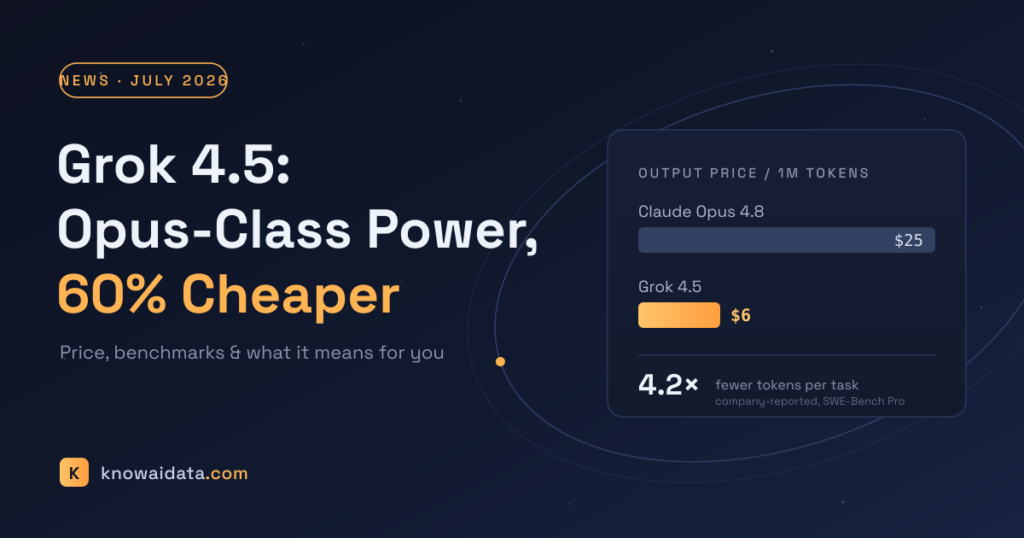
Grok 4.5, the newest flagship AI model from Elon Musk’s SpaceXAI (formerly xAI), launched on July 8, 2026, priced at $2 per million input tokens and $6 per million output tokens — a fraction of what rivals charge. The company is pitching it as a coding and knowledge-work model that matches Anthropic’s premium Claude Opus family, and Musk called it an “Opus-class model, but faster, more token-efficient and lower cost.” The launch is SpaceXAI’s first major release since the company went public and agreed to acquire the AI coding editor Cursor.
What Is Grok 4.5?
Grok 4.5 is SpaceXAI‘s most capable AI model to date, built specifically for coding, agentic tasks, and knowledge work such as research, writing, and document creation. It was trained alongside Cursor on real developer data, runs at roughly 80 tokens per second, and is available in Grok Build, Cursor, and the SpaceXAI API.
Unlike earlier Grok releases aimed mainly at chatbot users on X, this one is squarely targeted at developers and businesses. The company says the model was trained across tens of thousands of NVIDIA GB300 GPUs, with reinforcement learning covering hundreds of thousands of tasks centered on multi-step software engineering.
Grok 4.5 Benchmarks: A Mixed Picture vs Claude Opus 4.8
SpaceXAI’s launch page presents four coding benchmarks — and read carefully, they tell a more nuanced story than the “Opus-class” framing suggests.
Where Grok 4.5 wins: On DeepSWE 1.0, Grok 4.5 scored 62.0% against Claude Opus 4.8’s 55.75%. It also topped the SWE Marathon resolution benchmark at 29.0%, ahead of Opus 4.8 (26.0%) and even Anthropic’s newest flagship, Claude Fable 5 (24.0%). On Terminal-Bench 2.1, it essentially tied the leaders at 83.3%.
Where it trails: On SWE-Bench Pro, a widely watched real-world software engineering test, Grok 4.5 resolved 64.7% of tasks — well behind Claude Fable 5’s 80.4% and Opus 4.8’s 69.2%. It also trailed both Fable 5 and GPT-5.5 on DeepSWE 1.1.
Independent testing broadly supports that middle-of-the-frontier position. Artificial Analysis, which evaluates models on a common harness, ranked Grok 4.5 fourth on its Intelligence Index with a score of 54 — behind Claude Fable 5, GPT-5.5, and Claude Opus 4.8, but ahead of every Gemini and open-weight model. Musk himself later clarified that internal assessments put Grok 4.5 “roughly comparable to Opus 4.7,” the previous-generation Anthropic flagship.
Bottom line: Grok 4.5 is genuinely near the frontier, but it isn’t the outright leader. Its real pitch is value, not victory.
Pricing: The Real Headline Is Token Efficiency
At $2 per million input tokens and $6 per million output tokens, Grok 4.5 dramatically undercuts premium rivals:
| Model | Input (per 1M tokens) | Output (per 1M tokens) |
|---|---|---|
| Grok 4.5 | $2 | $6 |
| Claude Opus 4.8 | $5 | $25 |
| OpenAI GPT (Luna tier) | $1 | $6 |
But per-token price is only half the story. SpaceXAI reports that Grok 4.5 solves SWE-Bench Pro tasks using about 15,954 output tokens on average, versus roughly 67,020 for Opus 4.8 — a 4.2x efficiency gap. If that holds up in independent testing, the effective cost-per-task savings would be far larger than the sticker price suggests. [VERIFY: independent replication of the token-efficiency figure is not yet available.]
Trained With Cursor — And Why That Matters
Grok 4.5 is the first model released since SpaceX’s acquisition of xAI (the combined entity now branded SpaceXAI) and the company’s June 2026 agreement to acquire Cursor, the popular AI coding editor, in a deal reported at $60 billion. Training the model alongside Cursor gave SpaceXAI access to real developer workflows — the kind of multi-step debugging and tool-use data that benchmark-focused training often misses.
That is also why Grok 4.5 launched as the default model inside Cursor on all plans from day one, giving it instant distribution to millions of developers.
Beyond Coding: Excel, PowerPoint, and Word
SpaceXAI is positioning Grok 4.5 as more than a developer tool. Through its Office plugins, the model can build multi-sheet Excel financial models with live web research, design PowerPoint slides using native shapes, and draft documents in Word. That puts Grok directly inside the daily workflow of knowledge workers who may never touch an API.
Where You Can Use Grok 4.5 Today
- Grok Build — SpaceXAI’s coding agent, where Grok 4.5 is now the default (free usage for a limited time)
- Cursor — available on all plans
- SpaceXAI API — model name
grok-4.5, supporting both Responses and Chat Completions formats - Third-party platforms — including OpenRouter, Vercel, Cloudflare, Snowflake, and Databricks
One major gap: Grok 4.5 is not yet available in the EU in any SpaceXAI product or the API console. The company says EU availability is expected in mid-July 2026.
What This Means for You
If you’re a developer or startup: Grok 4.5 is worth benchmarking against your current model, especially for agentic coding workloads where its token efficiency could cut costs by half or more. Just don’t assume the company’s benchmark selection reflects your use case — run your own evals.
If you’re a business decision-maker: The AI race is shifting from “who is smartest” to “who delivers the most intelligence per dollar.” Grok 4.5 is the clearest signal yet that near-frontier capability is becoming a commodity — good news for your AI budget.
If you’re just AI-curious: You now have three genuine frontier players (Anthropic, OpenAI, and SpaceXAI) instead of two, which historically means faster releases and lower prices across the board.
For the latest AI news, guides, and tool reviews, visit the Know AI Data.