
AI News

ChatGPT Health Integrates With Epic EHR: What Doctors and Patients Need to Know

September 3, 2026
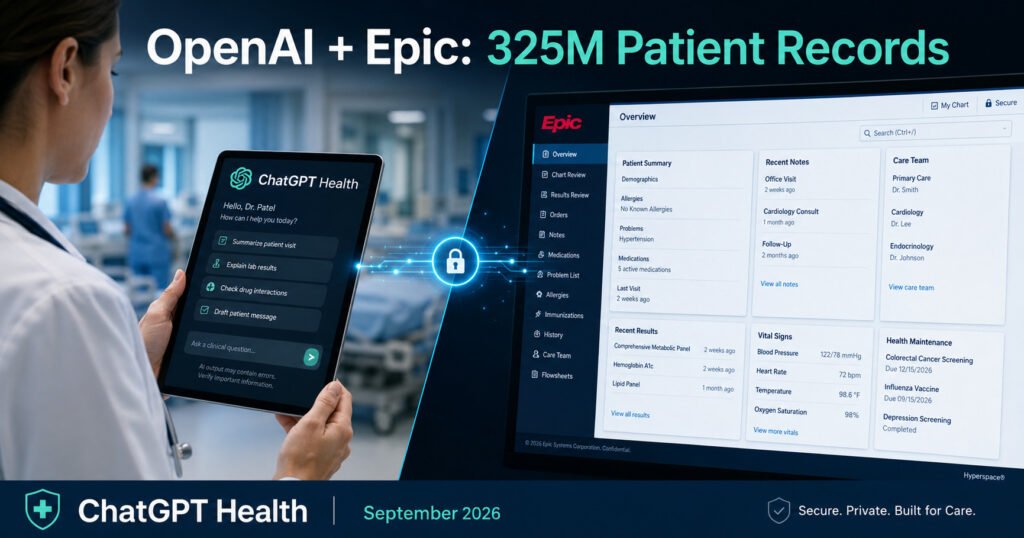
OpenAI has connected ChatGPT directly to Epic Systems, the electronic health record (EHR) platform holding data for more than 325 million patients, the company announced on September 1, 2026. The integration gives authorized clinicians the ability to pull appointment notes, lab results, medications, and specialist documentation into a ChatGPT chat window — without leaving their existing workflow. It marks OpenAI’s deepest move yet into enterprise clinical AI.
What Is the ChatGPT Epic EHR Integration?
Epic Systems is the dominant electronic health record platform in the United States, used by the majority of large hospital networks to store and manage patient medical histories. Think of it as the operating system most American hospitals run on behind the scenes.
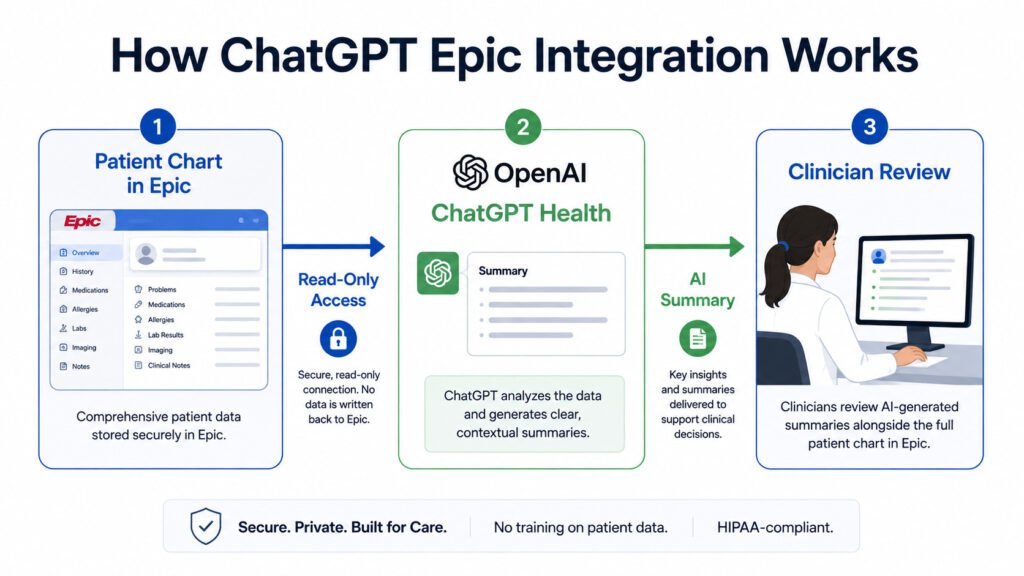
The new integration gives authorized healthcare teams read-only access to patient records inside ChatGPT for Healthcare. That means clinicians can ask questions like “What has changed since this patient’s last visit?” and receive an AI-assembled answer drawn from across the patient’s chart — in seconds.
The architecture works in two modes: clinicians can pull Epic patient data into a ChatGPT environment for chart review, and in some hospital systems, ChatGPT is embedded directly inside the Epic interface itself.
The key constraint: Access is read-only. ChatGPT cannot write to the patient record, cannot place orders, and cannot alter clinical documentation through this integration. That boundary is deliberate — and important for anyone worried about AI making changes to medical files without human oversight.
Is This HIPAA Compliant?
For any integration touching patient data in the United States, HIPAA — the federal law governing health information privacy — is the critical question.
OpenAI signed a Business Associate Agreement (BAA) for read-only Epic access. A BAA is the legal contract that establishes HIPAA-compliant responsibilities between a hospital and a technology vendor. Without it, the integration could not lawfully access protected health information.
Organizations with a BAA in place can also deploy ChatGPT Work and Codex alongside the Epic integration.
It is worth noting that HIPAA applies specifically to US law. Healthcare systems in other countries operate under different — and sometimes weaker — data protection frameworks, and OpenAI has not announced equivalent arrangements internationally.
How Safe Is ChatGPT for Clinical Use?
OpenAI released internal safety figures alongside the announcement. Physicians evaluated ChatGPT responses across 27 clinical use cases including medication review and handoff summaries, with over 4,300 ratings finding 99.1% of responses safe for clinical environments. A separate review of 6,924 conversations rated 99.6% safe and accurate.
Those numbers look strong. But context matters.
OpenAI reportedly recorded more than 300 million health-related queries per week as of July 2026. Apply even a 0.9% imperfect-response rate to that query volume and the raw count of potentially problematic outputs becomes a patient-safety variable — not just a rounding error in a product announcement.
The 99.1% rating derives from internal evaluations and has not been submitted for independent peer review. That does not make the data invalid, but it is a meaningful distinction in a clinical setting where independent validation is a standard expectation.
OpenAI itself has been clear: despite these integrations, ChatGPT is not suitable for diagnosis or treatment. It is a tool to assist clinicians, not replace clinical judgment.
What Else Launched: The Healthcare Public Data Plugin
Alongside the Epic integration, OpenAI quietly launched a second feature that could matter as much for everyday health research.
The Healthcare Public Data plugin provides structured access to nine official datasets, including ClinicalTrials.gov, PubMed, RxNorm, DailyMed and Medicare coverage data.
For patients, researchers, and healthcare professionals, this means ChatGPT can now draw on authoritative medical databases to answer questions about drug information, clinical trial eligibility, and treatment guidelines — without users needing to manually navigate those individual platforms.
OpenAI’s Healthcare Timeline: How We Got Here
This week’s announcement is not a standalone product launch — it is the latest step in a deliberate expansion that has accelerated throughout 2026:
- January 2026: ChatGPT Health launched as a limited pilot
- July 2026: ChatGPT Health expanded to all US adults 18 and older; health-related queries hit 300 million per week
- September 1, 2026: Epic EHR integration and Healthcare Public Data plugin announced; UCSF Health named as a pilot partner
- Seven health systems are confirmed launch partners [VERIFY: full list not yet publicly released]
What This Means for You
If you are a patient: Your doctor may soon be able to review your entire medical history faster and more accurately before appointments. The integration is read-only — ChatGPT cannot change your records. However, if your hospital uses Epic and has enabled this integration, your record data can be processed by OpenAI’s systems under HIPAA terms. You have the right to ask your provider whether this integration is active and what data is accessed.
If you work in healthcare: The practical upside is significant — less time reconstructing patient histories, faster chart review, and a direct connection to public medical databases for reference. The practical caution is equally clear: the tool is an assistant, not a clinician. Its safety data comes from OpenAI’s own internal reviews, not independent audits.
For the broader AI industry: This integration signals that AI companies are no longer testing healthcare use cases in sandboxes. They are embedding AI directly into the workflows of major hospital systems, at scale. The regulatory and liability frameworks are still catching up.
For daily Artificial Intelligence news follow KnowAIData