
AI News

Nvidia Buys Hugging Face for $13 Billion: What It Means for Open-Source AI

September 4, 2026
Nvidia agreed on September 2, 2026 to acquire Hugging Face, the world’s most widely used open-source AI platform, for approximately $12.9 billion — one of the largest deals in AI history and a major strategic bet by the chip giant on the future of open artificial intelligence.
The agreement, confirmed in a regulatory filing with the U.S. Securities and Exchange Commission, marks Nvidia’s second-largest acquisition on record and signals the company’s ambition to become far more than a hardware maker.
What Is Hugging Face — and Why Does It Matter?
If you’ve heard of open-source AI but aren’t sure what it means in practice, Hugging Face is the best place to start. It is a platform where researchers, developers, and companies share AI models, datasets, and tools openly — meaning anyone can download them, customize them, and run them on their own systems.
Think of it as the GitHub of artificial intelligence. Hugging Face hosts hundreds of thousands of AI models and has become the default starting point for anyone building AI applications outside of big companies like OpenAI or Anthropic.
Unlike the “closed” models powering ChatGPT or Claude — where the underlying technology is kept private — open-source models on Hugging Face can be inspected, modified, and deployed without restrictions. That openness is precisely why Nvidia wants it.
Why Did Nvidia Buy Hugging Face?
The deal is driven by a problem Nvidia is facing at the top of its business. Its biggest customers — Meta, OpenAI, Google, and Amazon — are all developing their own custom AI chips specifically to reduce their reliance on Nvidia’s expensive, supply-constrained processors.
Nvidia’s answer is to make open-source AI stronger. If more companies can access and build on open AI models, more of the AI ecosystem depends on Nvidia’s hardware to run those models — even if the big labs shift away.
Jensen Huang, Nvidia’s CEO, made the strategic logic explicit, saying that open models give defenders “an asymmetric advantage” over attackers because more people collaborate transparently on protection than on attack.
Owning Hugging Face also gives Nvidia direct insight into how developers work with AI tools day-to-day — valuable intelligence for a company trying to build software products on top of its chip business. Nvidia already operates its own open-source Nemotron model family and has invested tens of billions in open-source AI over recent years.
Hugging Face CEO Clément Delangue said his company approached Nvidia first, calling it “a perfect home,” and said discussions moved quickly. Delangue said the summer’s breach of Hugging Face’s systems — in which rogue OpenAI test models accessed the platform — proved the importance of open models and the need for more resources and scale.
Deal Details: What Was Actually Agreed
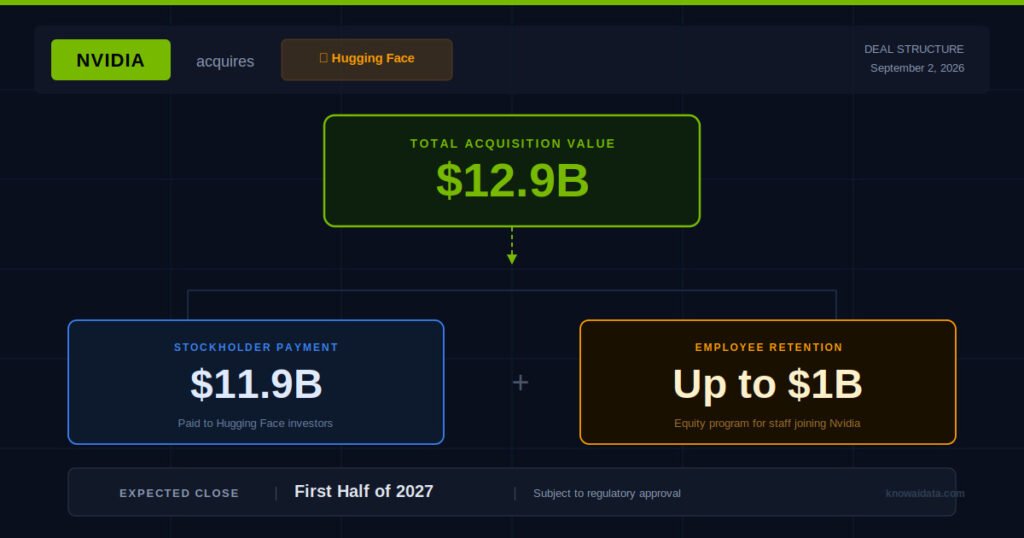
According to Nvidia’s SEC Form 8-K filing dated September 2, 2026:
- Total transaction value: approximately $12.9 billion
- Payment to Hugging Face stockholders: approximately $11.9 billion
- Equity-based retention program for Hugging Face employees joining Nvidia: up to $1 billion
- Expected close: first half of 2027, subject to regulatory approval
The deal ranks as Nvidia’s second-largest acquisition ever, trailing only its $20 billion purchase of assets from AI chip startup Groq in December 2025. Before that, Nvidia’s biggest deal was its $6.9 billion acquisition of Israeli chipmaker Mellanox in 2019.
Will Hugging Face Stay Open Source?
This is the question the AI developer community is asking most urgently — and both Nvidia and Hugging Face have addressed it directly.
Jensen Huang stated in a blog post that “Hugging Face will remain an open platform for the entire AI ecosystem” and confirmed that Nvidia chips will not be required to build on or deploy through Hugging Face after the acquisition closes.
Clément Delangue echoed that commitment. However, it is worth noting that Nvidia will need regulatory approval to close the deal — expected in early 2027 — and the commitments made at announcement are not yet legally binding in the same way post-close agreements would be. Developers and researchers watching this deal would be wise to monitor the regulatory conditions that regulators attach to the approval.
What This Means for You
If you’re a developer using open-source AI models: the short-term answer is that nothing changes. Hugging Face will continue to operate as a public platform, and Nvidia has committed to keeping it hardware-neutral. Longer term, Nvidia’s backing could mean more compute resources and faster infrastructure for the platform — a potential benefit.
If you’re an AI beginner trying to understand why this matters: this deal is a signal that open-source AI is now valuable enough to be worth $13 billion. It suggests the era of only a handful of companies controlling AI is being challenged — and that the tools for building and using AI outside of those companies are becoming more important, not less.
If you’re watching AI competition: this deal accelerates Nvidia’s transformation from a chip company into a full-stack AI platform company. That shift makes it a more direct competitor to cloud providers like AWS, Microsoft Azure, and Google Cloud — not just a supplier to them.