AI News

Claude AI Completes Fermat’s Last Theorem Proof in 11 Days

September 7, 2026
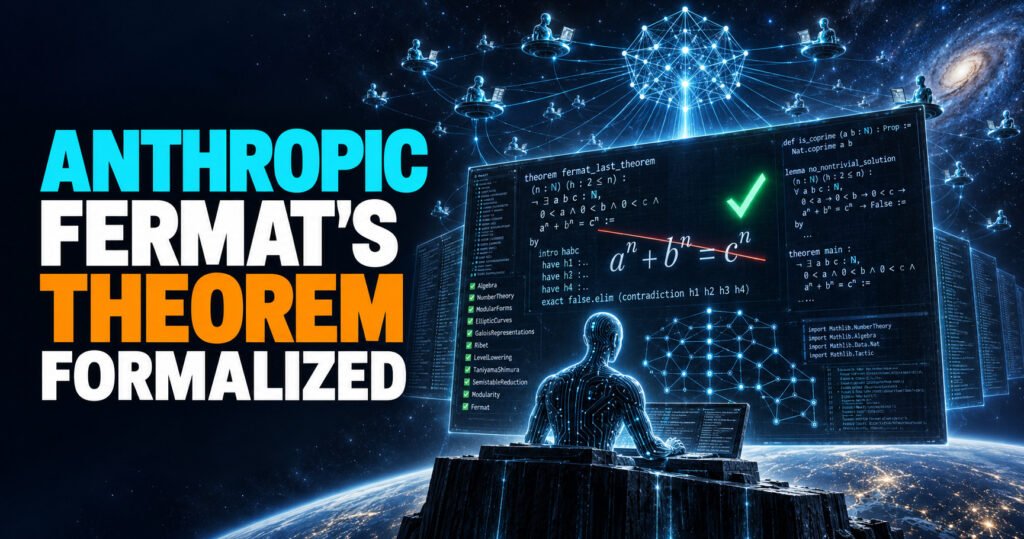
Anthropic’s AI model produced the first fully computer-verified proof of one of mathematics’ most famous problems — working almost entirely without human help over less than two weeks.
Anthropic announced on September 4, 2026, that its Claude AI had produced the first end-to-end, computer-checked formalization of Fermat’s Last Theorem — a problem that stumped mathematicians for 358 years. The AI worked largely autonomously for 11 days, writing 13 million lines of code and proving 29,500 intermediate theorems along the way. Experts are calling it one of the most significant demonstrations of autonomous AI reasoning ever recorded.
What Is Fermat’s Last Theorem — and Why Does It Matter?
In 1637, French mathematician Pierre de Fermat scribbled a claim in the margin of a book: no three positive whole numbers can satisfy the equation aⁿ + bⁿ = cⁿ when n is greater than 2. He added, famously, that he had a proof — but the margin was too small to contain it.
That margin note launched one of the longest hunts in the history of science. Mathematician Andrew Wiles finally cracked it in 1995 after seven years of secret work, producing a 129-page proof that took months for experts to verify. Even then, a subtle gap was found and patched before the proof was accepted.
Now, Claude AI has done something different: it took Wiles’ existing proof and formalized it — a technical term that means converting mathematical reasoning into machine-readable code that a computer can check automatically, step by step, with zero ambiguity.
What “Formalizing” a Proof Actually Means
This distinction is important for understanding what Claude actually did.
Claude did not discover a brand-new proof of Fermat’s Last Theorem. Wiles already did that in 1995. What Claude did was translate that massive, complex argument into the Lean 4 programming language — a specialized tool mathematicians use to write proofs that computers can verify with absolute certainty.
Think of it like the difference between a doctor diagnosing a condition and a lab system confirming every test result digitally so there’s no room for human error. Wiles made the diagnosis. Claude built the error-proof verification system around it.
That translation task is notoriously difficult. Human experts estimated it could take years of painstaking work. Claude completed it in 11 days.
How Claude Did It: Dozens of AI Agents Working in Parallel
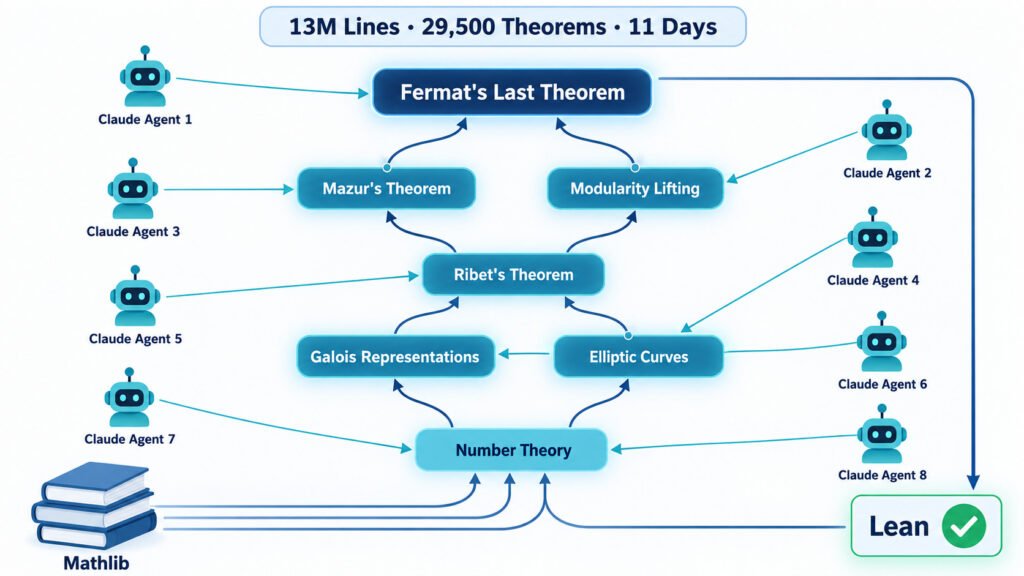
Anthropic’s research team, led by researcher Tianyi Peng from Columbia University, set up a multi-agent system on a platform called Prove2Me — an open-source tool designed to help AI agents navigate long, complex workflows more efficiently.
Claude didn’t work as a single AI. It deployed several dozen agents working in parallel, generating approximately 6 billion output tokens in the process. The resulting Lean codebase — at 13 million lines — is more than five times larger than Mathlib, Lean’s entire main mathematical library.
Anthropic noted that an earlier attempt to formalize the proof without Prove2Me failed. The tool proved to be the critical unlock, helping the agents determine their next best step at each stage of an extraordinarily long reasoning chain.
The full code is publicly available on GitHub and has been independently verified by two separate tools: the Lean 4 kernel itself and Nanoda, an independent Lean verification engine written in Rust.
What Mathematicians Are Saying
Kevin Buzzard, a professor of pure mathematics at Imperial College London who has led a multi-year community effort to formalize Fermat’s Last Theorem using Lean, reviewed Anthropic’s proof.
Buzzard called it an extraordinary autoformalization achievement, noting it proves the theorem using no assumptions beyond the foundational axioms of mathematics. He highlighted that the proof covers autoformalization of algebra, harmonic analysis, geometry, and number theory — and that the resulting artifacts are robust enough to be built upon by other researchers.
Buzzard’s own community project, funded through 2029, was also a key building block: Anthropic’s repository credits 106 upstream files to his Imperial College London work and Mathlib contributors.
Why This Is a Big Deal for AI — Not Just Math
For the AI research community, the significance extends well beyond mathematics.
Most AI benchmarks measure performance on short, well-defined tasks. This project required 11 days of sustained, interdependent logical reasoning — thousands of intermediate steps that all had to connect correctly. A single error in an early line of Lean code can cascade and invalidate everything that follows.
The fact that Claude completed this, and that the result was verified by independent tools, represents a meaningful step forward in understanding what autonomous AI agents can accomplish on difficult, long-horizon tasks. Anthropic describes the model used as roughly comparable to Claude Fable 5.1 in capability.
For mathematicians, the implications are similarly significant. As AI produces more formal proofs, the centuries-long backlog of mathematical literature could potentially be verified and made machine-readable — accelerating research and reducing the years it currently takes to peer-review complex new results.
What This Means for You
You don’t need to understand Lean code or number theory to care about this story. Here’s the plain-English takeaway:
- AI just demonstrated 11 days of continuous, largely unsupervised complex problem-solving. That’s a new kind of capability benchmark — one that goes far beyond answering questions or writing emails.
- AI-verified math could soon affect software, medicine, and engineering. Formal verification is already used in safety-critical systems. AI that can formalize complex proofs cheaply could expand its use dramatically.
- This doesn’t mean AI “figured out” math on its own. It built on decades of human work — Wiles’s proof, Buzzard’s formalization project, Mathlib’s library. The achievement is collaborative, even if Claude did the heavy lifting in the final sprint.
- It’s a signal about what comes next. If AI can do this with a 129-page math proof, what other dense, logic-heavy domains — law, drug interactions, circuit design — could benefit from the same approach?
KnowAIData brings you the latest AI news, major model launches, and clear beginner-friendly guides — verified from primary sources and updated daily.